Every throttle twist is a contract with physics. Your bike either delivers what you ask for, or it lies—through vague brakes, lazy throttles, and vague feedback. The difference isn’t just brand or model; it’s maintenance discipline. Not the “wipe it with a rag and check the chain” kind, but engineering-grade care that keeps your motorcycle mechanically honest, repeatable, and predictable at lean.
This isn’t about showroom shine. It’s about torque that arrives exactly when you demand it, braking that feels identical lap after lap, and a chassis that talks to you instead of surprising you. If you ride hard, fast, or far, this is the maintenance mindset you should be chasing.
1. Torque Accuracy: Why Proper Fastener Tightening Changes How Your Bike Feels
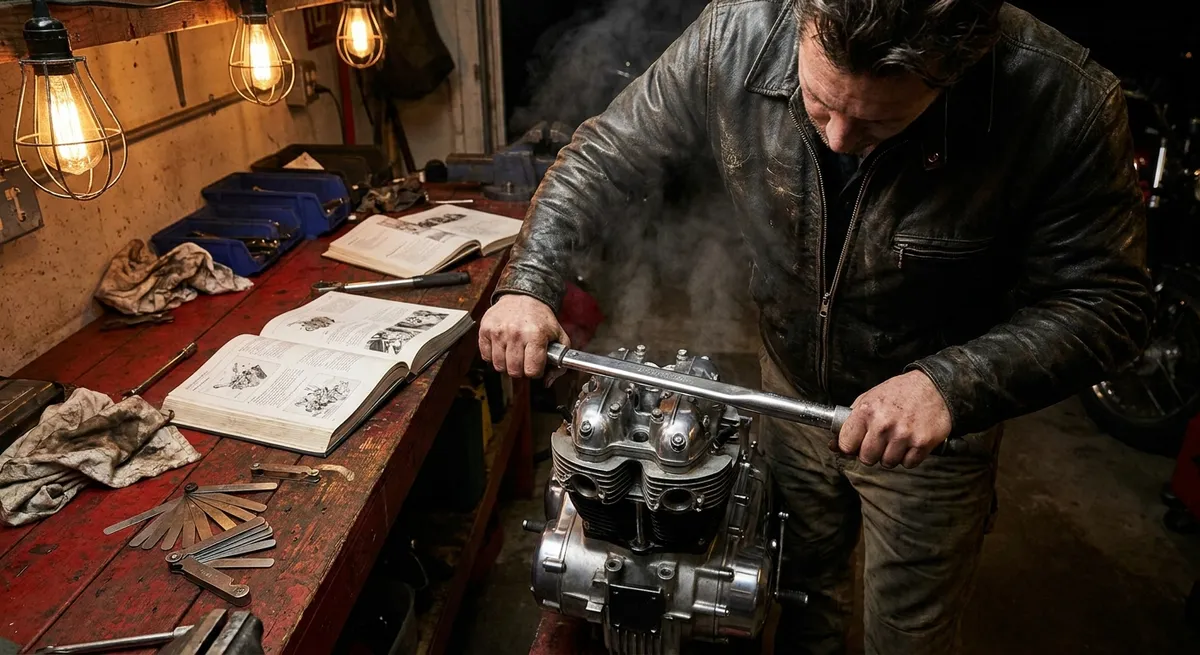
Most riders think of torque specs as “don’t strip the threads.” In reality, accurate torque is about controlling clamping force, which directly affects handling, feedback, and reliability.
When you torque to spec, you’re not just “tightening a bolt”; you are setting a known preload in the joint:
- Fork pinch bolts: Too tight and you distort the fork leg, increasing stiction and killing small-bump compliance. Too loose and the axle can shift slightly, altering fork alignment and introducing vague steering. The result is a front end that feels different mid-corner than it does on turn-in.
- Triple clamp pinch bolts: Uneven torque here can twist your fork tubes, leading to binding, inconsistent rebound feel, and a bike that tracks differently left vs. right.
- Brake caliper bolts: Proper torque keeps the caliper square to the disc. Under-torqued bolts can let the caliper rock microscopically, affecting pad knockback and lever feel. Over-torqued bolts stretch threads and can compromise long-term reliability.
- Rear axle nut and adjusters: Correct torque and symmetrical chain adjuster position keep the rear wheel aligned. Even small misalignment changes how the bike finishes a corner and how the chain loads the sprockets.
Practical implementation:
- Use a quality 3/8" drive torque wrench for most chassis fasteners, and a 1/4" torque wrench for smaller hardware like controls and bodywork.
- Clean threads, use the specified lubricant or threadlocker (dry vs. oiled threads change actual clamping force at the same torque number), and follow the manufacturer’s tightening sequence.
- Treat any fastener that affects alignment—axle pinch, triple clamps, rear axle, brake calipers—as a performance component, not just hardware.
Correct torque isn’t “nice to have”; it’s how you make the bike feel repeatable from ride to ride.
2. Brake System Integrity: Engineering Predictable Stopping Power
Your brakes are a hydraulic force translator: lever input → system pressure → pad friction → tire load. Any weak link in that chain shows up as vague feel, extra lever travel, or inconsistent response—deadly on the street and unacceptable on the track.
Key technical points for enthusiasts:
Fluid condition and boiling point
Brake fluid is hygroscopic—it absorbs water over time, which: - Lowers its boiling point, increasing fade risk under heavy use. - Promotes internal corrosion in master cylinders and calipers.
For aggressive riders, swapping fluid at least once a year (more if you ride hard in the mountains or on track) keeps the system stable. Look for wet/dry boiling point specs and match to your use; DOT 4 is standard, high-performance DOT 4 is preferable to DOT 5.1 for most street/track riders due to stability and availability.
Pad material and transfer layer
Pads don’t just “bite”—they create a transfer layer on the rotor surface. Mixing pad compounds (e.g., track pads, then back to street pads) without prepping the rotor can cause uneven friction and pulsing that feels like a warped disc. If changing pad types: - Lightly scuff rotors with fine emery cloth. - Clean with brake cleaner. - Bed the new pads properly with progressive stops from moderate speed.
Line condition and expansion
Rubber lines expand with age and heat, softening lever feel. Braided stainless lines reduce volumetric expansion under pressure, making the relationship between lever travel and pressure more linear. If your bike is 5–7+ years old and still on OEM rubber lines, upgrading isn’t just a “mod”—it’s a functional safety upgrade.
Caliper service
Piston seals age, and dust seals can drag. Symptoms: - Uneven pad wear. - Brake drag when pushing the bike. - Inconsistent lever feel after heat cycles.
A proper caliper service includes:
- Removing pads and cleaning pistons with appropriate brake cleaner.
- Gently cycling pistons out and in to verify free movement.
- Replacing seals per service manual intervals or when contamination is visible.
Lever ratio and feel
Adjustable levers aren’t just ergonomic—they change the effective lever ratio and perceived modulation. Dialing in a lever reach that lets you operate the brake with a consistent 2-finger pull, using the stronger part of your hand, yields more precise control under hard braking.
When you maintain the brake system with this level of attention, you don’t “hope” the brakes will be there—you know exactly how they’ll feel every time.
3. Fuel and Air: Calibrating the Engine for Consistent Throttle Response
Enthusiast riders often feel the engine as “powerful” or “soft,” but what matters at the limit is predictability—a throttle that responds linearly and repeatably to input. That predictability is built on correctly maintained intake and fueling systems.
Core areas to focus on:
- Air filter performance vs. protection
A partially clogged filter restricts airflow, richening the mixture and dulling response. An over-oiled performance filter can contaminate MAF/MAP or intake sensors (on EFI bikes), causing inconsistent fueling. Follow this approach:
- Inspect the filter at intervals suited to your environment (dusty or rainy riding demands shorter intervals).
- If using a serviceable/oiled filter, apply oil sparingly and evenly, let it wick fully, then wipe excess.
- For track or high-load usage, err on the side of filtration + consistency over tiny theoretical airflow gains.
Throttle body and intake tract cleanliness
EFI bikes with ride-by-wire or cables still depend on clean throttle plates and idle circuits. Deposits can: - Affect idle stability. - Introduce slight hesitation at small throttle openings. - Cause uneven cylinder balance on multi-cylinder engines.
Periodically inspect and clean throttle bodies using manufacturer-approved cleaners, and synchronize multi-cylinder throttles per the service manual to balance airflow between cylinders.
Injector performance and spray pattern
Fuel injectors don’t just “flow fuel”; they deliver a specific spray pattern and droplet size. Dirty injectors can lead to: - Uneven cylinder temps. - Hesitation under load. - Poor throttle pickup out of corners.
Periodic use of high-quality fuel system cleaner can help, but for high-mileage or hard-used bikes, professional ultrasonic cleaning and flow testing of injectors restores baseline performance.
Fuel quality and knock control
Using fuel below the recommended octane can induce knock, forcing the ECU (on modern bikes) to pull timing. You feel this as: - Softer midrange. - Less crisp throttle. - Surging at steady throttle on some mappings.
Use the recommended octane for your engine. If tuned or high compression, be honest about your fuel availability and choose a map/calibration that matches real-world fuel, not the one “that makes the biggest number” on a dyno.
Cable and throttle tube condition (for non ride-by-wire)
A sticky, dry, or kinked throttle cable changes your effective throttle map. Lube and route cables correctly, ensure smooth return, and verify no binding with bars turned full lock left/right. A consistent return force is a big part of precise throttle modulation.
When air, fuel, and throttle control are maintained as a system, the engine becomes a precise tool instead of a moody partner.
4. Suspension Health: Oil, Bushings, and the Reality of “Feel”
Suspension performance is not just “set your sag and clickers.” Internal condition—fluid, bushings, seals—matters as much as external adjusters. Many riders are effectively tuning around worn-out suspension and blaming the bike or tires.
Key technical maintenance points:
Fork oil degradation and viscosity drift
Fork oil doesn’t just get dirty; its viscosity changes with shear and temperature cycles. This: - Alters compression and rebound damping curves. - Can make clicker settings meaningless compared to the original tune.
For riders who push the bike (sport touring, canyon riding, track), a fork service every ~20,000–30,000 km (12,000–18,000 miles) or every 2–3 years is realistic. The result is instantly noticeable: more support on brakes, better mid-corner stability, and cleaner feedback.
Shock fade and nitrogen charge
Most OEM shocks are sealed and non-rebuildable, but that doesn’t mean they last forever. Oil aeration and loss of nitrogen pressure cause: - Reduced damping after repeated hard hits or long twisty runs. - “Pogo-stick” behavior over bumps. - Rear-end squat and wallow on corner exit.
If your shock is rebuildable, follow the service interval (often around 20,000–30,000 km). If not, consider replacement with a properly valved aftermarket unit once you out-ride the stock setup or see clear signs of fade and leakage.
Bushing and seal condition
Worn fork bushings increase stiction and let the fork bind under side-loads (braking into corners, mid-corner bumps). This: - Masks tire feedback. - Can make a bike feel “nervous” at lean.
A proper fork rebuild includes inspecting and replacing wear bushings, not just seals. This returns the fork to its designed friction level.
Linkage and swingarm bearings
Rear suspension performance depends on low-friction pivots: - Dry linkage bearings introduce hysteresis—different motion on compression vs. rebound—leading to harshness and poor grip. - Corroded swingarm bearings affect alignment and feedback.
Disassemble, clean, and re-grease linkage and swingarm bearings at manufacturer-recommended intervals (or sooner if you ride in rain, salt, or off-road). Use a quality waterproof grease, and torque all fasteners to spec afterward.
Alignment and chassis baseline
After any major suspension service: - Verify fork tube height in the triples is consistent left/right. - Confirm axle alignment and that the wheel spacing/spacers are correct and properly seated. - Re-check sag and clickers and log your new baseline settings.
Healthy suspension isn’t just comfort—it’s how the motorcycle expresses what the tire is doing. Without that, you’re riding half-blind.
5. Electrical Reliability: Voltage, Ground Paths, and Sensor Integrity
Modern motorcycles are rolling sensor networks. Throttle response, ABS, traction control, and even charging all depend on clean electrical signals. You can have perfect mechanicals and still suffer from erratic behavior if your electrical system is neglected.
Important technical aspects:
Charging system health (stator, regulator/rectifier, battery)
Undercharging or overcharging causes: - Weak starts and intermittent stalling at low RPM. - Strange ECU behavior when voltage drops below design range. - Premature battery failure.
Use a multimeter:
- Check resting battery voltage (typically ~12.6–12.8 V for a healthy, fully charged lead-acid).
- Measure charging voltage at idle and around 4–5k RPM (often ~13.5–14.5 V). Out-of-range values signal regulator or stator issues.
- Inspect connector blocks for discoloration, melting, or corrosion—common failure points.
- Disconnect main ground points.
- Clean mating surfaces to bare metal if corroded.
- Reassemble with proper torque; a light smear of dielectric grease on the external portion of the connection can help corrosion resistance (not between main conductive surfaces).
Ground integrity and resistance
The chassis ground is your return path for sensors, lights, and ECU circuits. High resistance at ground points can cause: - Intermittent sensor codes. - ABS or traction control errors. - Dim lights and erratic gauge behavior.
Periodically:
Connector sealing and routing
Vibration and weather exposure are the enemies of connectors: - Use dielectric grease on connector seals (not on actual contact surfaces unless specified) to reduce moisture ingress. - Ensure wiring looms are routed away from sharp edges and pinch points, with adequate slack for full steering lock. - Inspect high-stress points: headstock area, under seat, near exhaust.
Sensor cleanliness and mounting
Wheel speed sensors, ABS rings, throttle position sensors, and lambda (O2) sensors all require proper mounting and alignment: - Check wheel speed/ABS sensor gap against spec. - Ensure ABS rings are straight and free of bent or damaged teeth. - Keep O2 sensor wiring intact and away from heat. - Avoid spraying aggressive cleaners directly on sensors.
Battery maintenance and technology choice
- Keep terminals tight and clean—loose battery connections cause some of the weirdest intermittent issues. - If running a lithium battery upgrade, ensure your charging system’s voltage range is compatible, and understand cold-weather starting behavior. - For any battery type: a smart tender used correctly maintains optimal charge and extends life, especially if the bike sits for more than a couple of weeks at a time.
In a modern motorcycle, stable electrical conditions are as important to performance as fresh oil. The ECU can only be as smart as the signals it receives.
Conclusion
Maintenance, at the level that serious riders deserve, isn’t just “keeping the bike running.” It’s engineering consistency into every ride.
Accurate torque keeps your chassis aligned and communicative. Healthy brakes turn lever pressure into repeatable deceleration. Clean, calibrated fueling systems give you a throttle that behaves the same on every exit. Fresh suspension internals keep the tire loaded correctly, not randomly. Stable electrics let your ECU and rider aids work as designed instead of guessing.
This is what separates a “bike that runs” from a motorcycle that feels like an extension of your nervous system.
If you ride for pace, precision, or pure connection, your maintenance routine is not a chore list—it’s the blueprint for how your bike behaves at the limit.
Sources
- Motorcycle Safety Foundation – RiderCourse Resources – General guidance on motorcycle inspection and maintenance priorities for safety-focused riding.
- U.S. National Highway Traffic Safety Administration (NHTSA) – Motorcycle Safety – Data and recommendations related to motorcycle equipment condition, braking, and visibility as safety factors.
- Yamaha Motors – Owner’s Manuals & Maintenance Guides – Real-world maintenance intervals, torque specs, and service procedures directly from a major OEM.
- Kawasaki Service Information – Owner’s Manuals – Factory service and maintenance specifications illustrating correct procedures for modern motorcycles.
- Öhlins USA – Suspension Service Information – Technical insight into suspension service intervals, oil degradation, and performance implications from a leading suspension manufacturer.
Key Takeaway
The most important thing to remember from this article is that this information can change how you think about Maintenance.