Most motorcycle reviews skim the surface: horsepower, seat height, maybe a line about “confidence-inspiring brakes.” For committed riders, that’s noise. You’re not buying a spec sheet or a press launch fantasy—you’re buying a dynamic system made of metal, oil, rubber, and data.
This is how to mine motorcycle reviews for what actually matters: the technical signals buried under the marketing gloss. When you know what to look for, a good review becomes less “opinion” and more “field test report.”
Below are five technical points that separate a casual ride impression from a review you can actually build a buying decision on.
1. Power Delivery: Not Peak Horsepower, Usable Torque
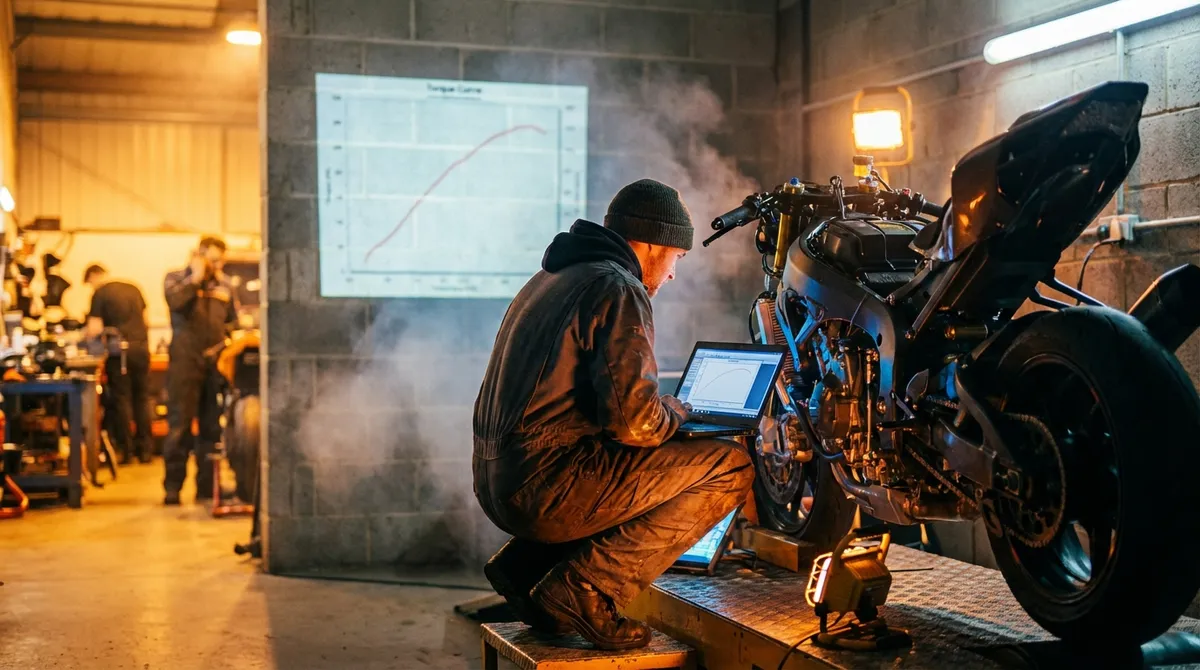
Peak horsepower numbers sell bikes. Torque curves determine whether you’ll actually enjoy them.
A serious review should describe where in the rev range the engine delivers meaningful thrust and how cleanly it connects to the rear tire. Phrases like “nothing below 6,000 rpm” or “strong midrange drive” matter more than “120 hp at the crank.” Look for commentary on how the engine responds to small throttle openings: is there abruptness at the on/off transition, or is it progressive and predictable? That’s real-world rideability.
Torque under the curve is what lets you carry a taller gear through a corner, roll on without a downshift, and launch out of a hairpin without lighting up the rear. Good reviewers will mention gearing interaction too: short final drive gearing masks weak torque but makes highway cruising buzzy; tall gearing can make an otherwise strong engine feel lazy.
When comparing reviews, prioritize consistent comments about:
- Midrange pull (3,000–8,000 rpm on most street bikes)
- Throttle modulation at low speed (parking lots, hairpins, U-turns)
- Drive out of corners vs. just straight-line acceleration
- How the engine feels with traction control minimally intrusive or off (if the tester mentions it)
If a review is obsessed with top-end rush but says nothing about part-throttle behavior, you’re missing the part you’ll use 90% of the time.
2. Chassis Feedback: What the Bike Tells You at Lean
Chassis performance is more than “stable” or “flickable.” A technically useful review digs into how the bike communicates load, grip, and direction changes.
You want specific language around:
- Initial turn-in: does the bike “fall in,” “resist,” or “roll predictably” into lean?
- Mid-corner support: does it hold a line without constant bar correction?
- Corner exits: does the rear feel planted when you ask for throttle, or does it squirm and wander?
Look for whether the reviewer ties these impressions to geometry and hardware: rake/trail values, wheelbase, wheel sizes, and tire profiles. A shorter wheelbase with steeper rake will feel reactive but may be nervous on rough, fast sweepers. A longer, lazier setup trades agility for high-speed composure. Serious testers will note when a bike’s geometry is tuned for fast sweeps vs. tight urban corners.
Feedback is the critical word. A well-sorted chassis lets the rider feel:
- When the front is loading (braking and turn-in)
- How the rear is squatting and driving under throttle
- Surface changes (tar snakes, seams, gravel) before they become surprises
If a review mentions “vague front end,” “dull feedback,” or “nervous on the brakes at lean,” those are red flags you should weigh heavily—especially if multiple independent reviews say the same thing.
3. Suspension Behavior: Dynamic Control, Not Just “Comfort”
Too many reviews summarize suspension with a single adjective: “firm,” “plush,” or “comfortable.” That’s useless without context. You want to know how the suspension manages energy—braking load, mid-corner bumps, and acceleration squat.
Pay attention to whether the reviewer addresses:
- Brake dive: excessive dive steals fork travel, steepens geometry too much, and overloads the front tire. A bit of dive is good for feel, but uncontrolled dive is a problem.
- Mid-stroke support: does the suspension “sit” too deep in the stroke under normal cornering, or does it ride high and controlled?
- Recovery: after a big bump, does the bike return to neutral quickly, or does it “pogo” and oscillate?
Technical reviews will mention adjusters: preload, compression, and rebound damping. Better yet, they’ll say what they changed and how the behavior improved or degraded. Comments like “needed more rebound at the rear to stop wallowing in fast sweepers” are gold; they tell you the bike can be tuned for serious riding instead of being fundamentally undersprung or underdamped.
Also look for:
- How it copes with sharp-edged bumps (potholes, expansion joints)
- Composure during aggressive braking from high speed
- Stability when leaned over on imperfect pavement
If every review says “great on smooth roads, unsettled when pushed on rough surfaces,” that’s a sign the stock suspension is at the edge of its competence for aggressive riding. That’s not a deal-breaker, but you should budget for springs, revalving, or cartridge kits if you plan to ride hard.
4. Braking System: Modulation, Heat Management, and ABS Logic
Braking performance is more than disc diameter and caliper brand. A serious rider needs to know what happens during repeated hard stops, downhill braking, and trail braking into corners.
Good reviewers will comment on:
- Initial bite: too soft and you can’t build pressure quickly; too aggressive and the bike feels grabby at low speed.
- Modulation: can you finely control deceleration with small lever pressure shifts, or is it binary?
- Fade resistance: do the brakes feel consistent after multiple high-speed stops, or does the lever travel increase and feel go vague?
ABS and electronic braking assist deserve technical scrutiny. Modern cornering ABS and linked systems can be a huge advantage—but only if the logic is smart. Reviews that mention “ABS pulsing early” or “overly intrusive rear ABS on rough pavement” tell you something about how the software is tuned.
Pay particular attention when testers describe:
- Behavior on bumpy braking zones (where ABS can be tricked)
- Rear wheel lift control or “stoppie control” and whether it cuts braking performance
- How the brakes feel in the wet (if tested)
Consistency is key. A powerful system that changes character as you heat it up is less useful than a slightly less aggressive one that stays predictable all day. When multiple riders say “excellent feel and zero fade after track sessions,” that’s meaningful data.
5. Electronics and Ergonomics as Performance Systems, Not Gadgets
Rider aids and rider fit are often dismissed as comfort or convenience, but they are performance multipliers when you treat them as systems.
A technical review should describe electronics in terms of:
- Intervention character: Does traction control smoothly taper power, or does it chop abruptly?
- Mode spacing: Are the different engine maps meaningfully distinct, or just marketing labels?
- Customization: Can you independently adjust throttle response, traction control, wheelie control, and ABS, or are you stuck with fixed bundles?
Good testers will evaluate electronics at the edge of grip, not just in casual commuting. Comments about “clean corner exits with TC set low” or “wheelie control cutting power mid-corner” tell you how much freedom you’ll have to ride the bike your way.
Ergonomics should be analyzed as part of the control loop, not as comfort fluff:
- Bar width and angle influence leverage and fine steering inputs.
- Peg position affects your ability to weight the pegs and move your hips across the bike.
- Seat shape determines how freely you can slide forward under braking and rearward on exit.
Look for reviewers who talk about body position transitions, knee lock-in on the tank, and how easy it is to brace under hard braking. That’s the difference between a bike you “sit on” and a bike you “wear” as a control interface.
Conclusion
Specs tell you what the factory built. Good reviews tell you how the system behaves under real loads, at real speeds, with a real rider. When you start reading reviews like a chassis engineer instead of a shopper, patterns emerge: consistent comments about torque shape, chassis feedback, suspension support, braking character, and electronics behavior.
Those patterns are where the truth lives.
Don’t just ask, “Is this bike good?” Ask:
- How does it make torque where I ride?
- What does the chassis tell me at lean?
- Can the suspension carry my pace on my roads?
- Do the brakes stay consistent when hot and hard-used?
- Do the electronics and ergonomics help me ride better, not just safer?
When a review answers those questions—explicitly or between the lines—you’re no longer buying marketing. You’re selecting a tool that will do exactly what you ask of it, mile after committed mile.
Sources
- [Motorcycle Consumer News – Understanding Motorcycle Dynamics (archived)](https://web.archive.org/web/20190915000000*/https://www.mcnews.com/understanding-motorcycle-dynamics) – In-depth explanations of chassis geometry, weight transfer, and handling behavior
- [Öhlins – Suspension Tuning Guide](https://www.ohlins.com/support/owners-manuals/motorcycle/) – Official manuals detailing how compression, rebound, and spring rates affect real-world suspension performance
- [Brembo – Motorcycle Braking Systems Technical Insights](https://www.brembo.com/en/company/news/motorcycle-braking-systems) – Technical articles on brake feel, heat management, and ABS integration in modern motorcycles
- [SAE International – Motorcycle Dynamics Technical Papers](https://www.sae.org/search/?taxonomy=24309) – Peer-reviewed engineering papers exploring tire forces, stability, and vehicle dynamics in motorcycles
- [Honda Powersports – IMU-Based Rider Aids Overview](https://powersports.honda.com/experience/articles/2020/01/technology-explained-what-is-an-imu) – Manufacturer breakdown of how modern traction control, wheelie control, and cornering ABS use IMU data
Key Takeaway
The most important thing to remember from this article is that this information can change how you think about Motorcycle Reviews.