Most motorcycle reviews stop where the riding starts. They tell you a bike is “nimble,” “planted,” or “torquey”—but not why. At Moto Ready, we care about the engineering beneath the adjectives. This guide breaks down how to read, write, and think about motorcycle reviews in a way that connects the data on the spec sheet to the forces going through your hands, feet, and contact patches on real roads.
This isn’t about hype. It’s about understanding the underlying mechanics so that when a reviewer says “front-end feel is vague on corner entry,” you know exactly what that means in terms of geometry, damping, and tire loading—and whether that matters for your riding.
How Chassis Geometry Shapes the Handling Story
When a review talks about “turn-in,” “stability,” or “mid-corner confidence,” it’s almost always a conversation about chassis geometry—even if the reviewer never uses the term.
Key parameters to watch in any technical review:
- Rake (caster angle): The angle of the steering head relative to vertical.
- Smaller angle (steeper rake) → quicker steering, more nervous at high speed.
- Larger angle (lazier rake) → more stable, slower to change direction.
- Trail: The distance between where the steering axis hits the ground and where the front tire actually contacts the ground.
- More trail → stronger self-centering, high-speed stability, heavier steering.
- Less trail → lighter, more agile steering, but can feel twitchy if pushed.
- Wheelbase: Distance between front and rear axle.
- Shorter wheelbase → faster direction changes, easier lofting the front, more reactive.
- Longer wheelbase → better high-speed stability, more composed with luggage/passenger.
How this shows up in a review:
- “Falls into the corner” often means: steep rake, shorter wheelbase, low front ride height.
- “Needs a firm push on the bar” often connects to: more trail, conservative rake, tall front.
- “Rock-solid at 130 mph but lazy in hairpins” almost always: long wheelbase plus generous trail.
A technical review should relate handling impressions to measurable geometry changes. For example, when a reviewer raises the rear ride height (via preload or ride-height adjuster), they’re effectively steepening rake and reducing trail, which explains quicker turn-in and potentially less high-speed stability.
Engine Character: Beyond Peak Horsepower Numbers
Motorcycle reviews that only cite peak horsepower and torque at max rpm are leaving most of the story untold. Riders live in the shape of the curve, not the headline number.
Technical points to look for:
- Torque plateau vs. torque spike
- A broad plateau between, say, 4,000–9,000 rpm means a flexible, forgiving engine that responds predictably to small throttle changes.
- A peaky curve with a big hit near redline can feel exciting on track but demanding or jerky in traffic.
- Crankshaft configuration (parallel-twin 270°, inline-four, V-twin, etc.)
- Firing order and crank layout affect vibration, traction feeling, and how the tire loads and unloads under power.
- Reviews that describe “excellent edge grip on corner exit” from a twin often reflect the more spaced-out power pulses that let the tire re-grip between bangs.
- Throttle mapping & ride-by-wire strategies
- Multiple riding modes are not just marketing: each map changes how much throttle plate angle you get for a given wrist input, and may change timing/fueling.
- A good review notes if “Rain” mode provides genuinely smoother low-speed control or just deadens the response.
- Engine braking behavior
- Modern bikes may use engine-brake control integrated with the ride modes.
- Technical reviews should mention whether aggressive engine braking unsettles the rear on corner entry or if electronic control smooths transitions.
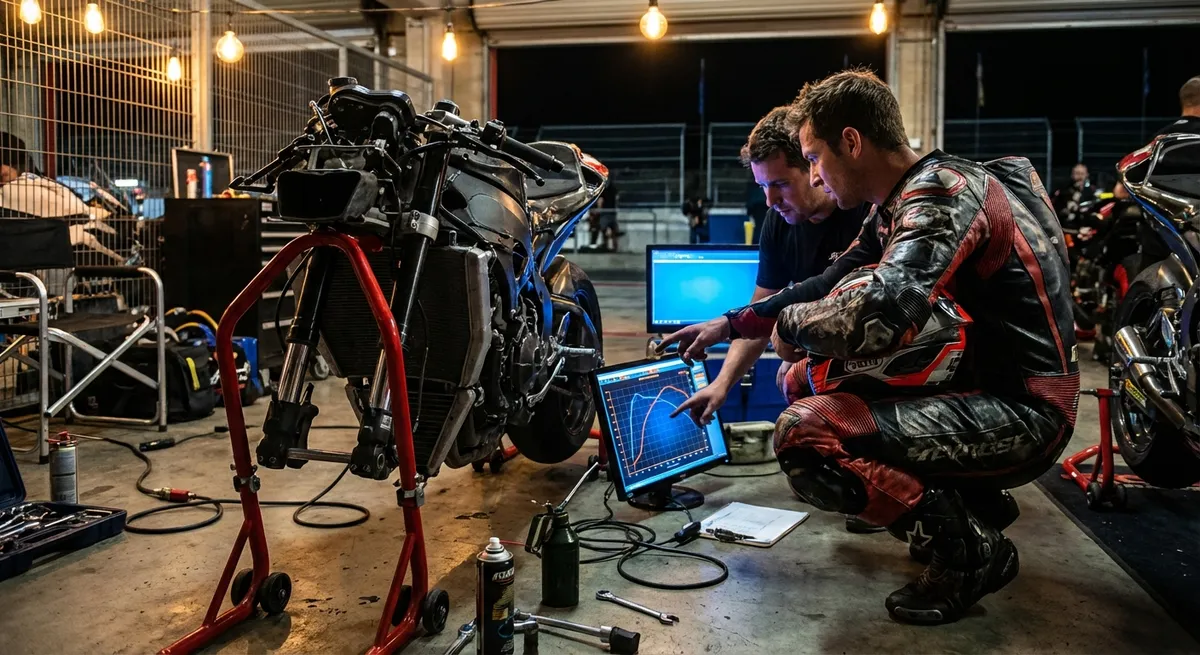
When you see dyno charts referenced in a review, focus on the 3,000–8,000 rpm band for street bikes—that’s where most real-world riding happens. A bike that “only” makes 95 hp but has a fat torque spread there can feel stronger on the road than a 120 hp screamer that wakes up only above 10k.
Suspension: The Real Filter Between Road and Rider
Suspension is where serious reviews separate themselves from brochure-speak. Any review worth your time should talk about what the suspension is doing and why.
Technical points to look for:
- Damping adjustability
- Rebound and compression adjusters are not just knobs to brag about; they’re control valves for how quickly the wheel moves in and out over bumps.
- “Underdamped” front end: excessive pogo effect after bumps, vague feel on the brakes, oscillation after sharp inputs.
- “Overdamped” suspension: harsh, skittering over sharp edges, reduced mechanical grip.
- Spring rates vs. rider weight
- A review that mentions rider weight is taking setup seriously. If a 160 lb tester says “suspension feels plush and controlled,” a 220 lb rider may be deep into the stroke all the time.
- Look for comments like, “Stock springs feel soft for aggressive riders over 90 kg.”
- Front-to-rear balance
- “Rear sits too low” → lazy turn-in, oversteer mid-corner, vague front feedback.
- “Front feels low” → quick tip-in, risk of instability, possible mid-corner nervousness.
- Electronic suspension systems
- If the bike uses semi-active suspension, a technical review should call out mode differences: firmer damping under heavy braking, adaptive behavior to load, and whether the system avoids wallowing in fast sweepers.
- The key question: does the logic keep the chassis settled under combined braking and cornering, or does it react too slowly?
When a reviewer describes “excellent bump compliance mid-corner and strong support on the brakes,” read that as: sufficient low-speed damping to control chassis pitch, plus enough high-speed compliance to let the wheel track sharp imperfections without transferring shock to the rider.
Braking Systems: Feel, Fade, and Real-World Performance
Brakes are more than “Brembo good, budget bad.” A serious review dissects braking in terms of hardware, feel, and thermal behavior.
Technical brake elements that matter:
- Calipers and master cylinder
- Radial-mount, monobloc calipers with a radial master cylinder generally deliver stronger, more consistent feel with less lever travel.
- But feel still depends on pad compound, line expansion, and master cylinder bore.
- ABS strategies
- Cornering ABS (IMU-based) vs. basic ABS makes a huge difference in how aggressively you can trail brake into a corner on the street.
- Technical reviews should note whether ABS cuts in early on rough surfaces, or allows firm deceleration without constant pulsing.
- Heat management and fade
- Reviews that include repeated high-speed stops or track use can reveal whether lever travel increases as temperatures climb, indicating fluid or pad limitations.
- Comments like “consistent lever with no fade after multiple hard laps” indicate robust brake system design and fluid management.
- Rear brake tuning
- A good review pays attention to rear brake effectiveness at low speed (u-turns, slow maneuvers) and its controllability for line adjustment mid-corner.
- Overly sensitive rear ABS can lengthen stopping distances on bumpy roads, something skilled reviewers will call out.
If a review provides stopping distance figures, pay attention to consistency across multiple tests. A bike that stops shorter but with wildly varying numbers might be traction-limited by its tire or ABS strategy, whereas a bike that stops slightly longer but consistently could be more confidence-inspiring in real use.
Electronics, IMUs, and the Invisible Hand of Stability Control
Modern reviews need to read like a dialogue with the bike’s ECU. Electronics are no longer an add-on—they are integral to how the machine rides.
Critical electronics aspects a technical review should address:
- Traction control logic and intervention feel
- Is TC cutting power abruptly or smoothly tapering torque?
- Does it allow a small amount of slip on corner exit, useful for sporty riding, or does it clamp down at the first hint of spin?
- IMU-enabled functions
- Lean-sensitive traction control, wheelie control, and cornering ABS all depend on accurate inertial data.
- A good review will highlight whether these systems feel transparent (letting you ride naturally) or intrusive (surprising cuts or corrections mid-corner).
- Mode integration
- The best systems tie throttle map, engine braking, traction control, ABS, and sometimes suspension into coherent modes: e.g., “Sport” maintaining sharp throttle with moderate TC, “Rain” using softer map with more intrusive TC and ABS.
- Look for whether custom modes let experienced riders keep full power but fine-tune safety nets.
- User interface and configuration
- Technical reviewers should evaluate menu structures, clarity of dashboards, and the practicality of on-the-fly changes (e.g., switching TC levels mid-ride without digging through submenus).
- Systems that are powerful but unusable at speed are, in practice, less effective.
When a review notes that “electronics never feel like they’re fighting you, only catching you,” that’s code for well-calibrated thresholds, smooth torque modulation, and logical mode separation—key signs of a mature electronics package rather than a marketing checkbox.
Five Technical Factors Enthusiasts Should Track in Every Review
For riders who want a concise technical checklist, these five points should always be on your radar when reading or comparing reviews:
Geometry & Weight Distribution
- Rake, trail, wheelbase, and how sag is set in the test. These define stability vs. agility and how quickly the bike reacts to your inputs.
Torque Curve & Rideability Band
- Where in the rev range the engine makes usable torque, plus how smooth or abrupt the throttle response is in that zone.
Suspension Control Under Combined Loads
- Not just comfort, but how the bike behaves when braking and turning over imperfect pavement. This exposes damping quality and chassis balance.
Brake Feel & ABS Strategy
- Initial bite, lever progression, fade resistance, and if cornering ABS or standard ABS changes the rider’s confidence at lean.
Electronics Integration, Not Just Presence
- Whether riding modes, traction control, wheelie control, and ABS work together coherently and are tunable enough for different skill levels and conditions.
When technical reviews explicitly address these five domains—with numbers where possible and specific riding scenarios—you gain the ability to “read” how a bike will feel before you ever throw a leg over it.
Conclusion
Motorcycle reviews shouldn’t be a collection of subjective adjectives; they should be a translation layer between raw engineering and real riding. Rake and trail become “high-speed stability.” Torque curves become “corner exit drive.” Damping curves become “confidence on rough backroads.” And electronics maps become “how hard you can lean on the bike when everything gets messy.”
When you start demanding this level of technical clarity from reviews—and learning to connect those details to your own riding style—you shift from buying motorcycles based on hype to choosing machines based on how their physics align with your roads, your pace, and your future skills.
That’s the Moto Ready mindset: every review is a data set, every ride is a test, and every spec is a clue to how the bike will feel at full lean, full brake, or full send.
Sources
- Motorcycle Geometry 101 – Yamaha Racing Academy – Technical overview of rake, trail, and wheelbase and how they affect handling
- SAE Technical Paper: The Influence of Motorcycle Design Parameters on Stability and Handling – Research paper analyzing how geometry and mass distribution change dynamic behavior
- Bosch Motorcycle Stability Control (MSC) – Official explanation of IMU-based ABS/TC functions and their effect on real-world safety
- Öhlins Motorcycle Suspension Setup Guide – Detailed documentation on spring rates, damping, and chassis balance from a leading suspension manufacturer
- Brake Systems for Motorcycles – Brembo Technical Insights – Technical breakdown of caliper design, master cylinders, and braking performance considerations
Key Takeaway
The most important thing to remember from this article is that this information can change how you think about Motorcycle Reviews.