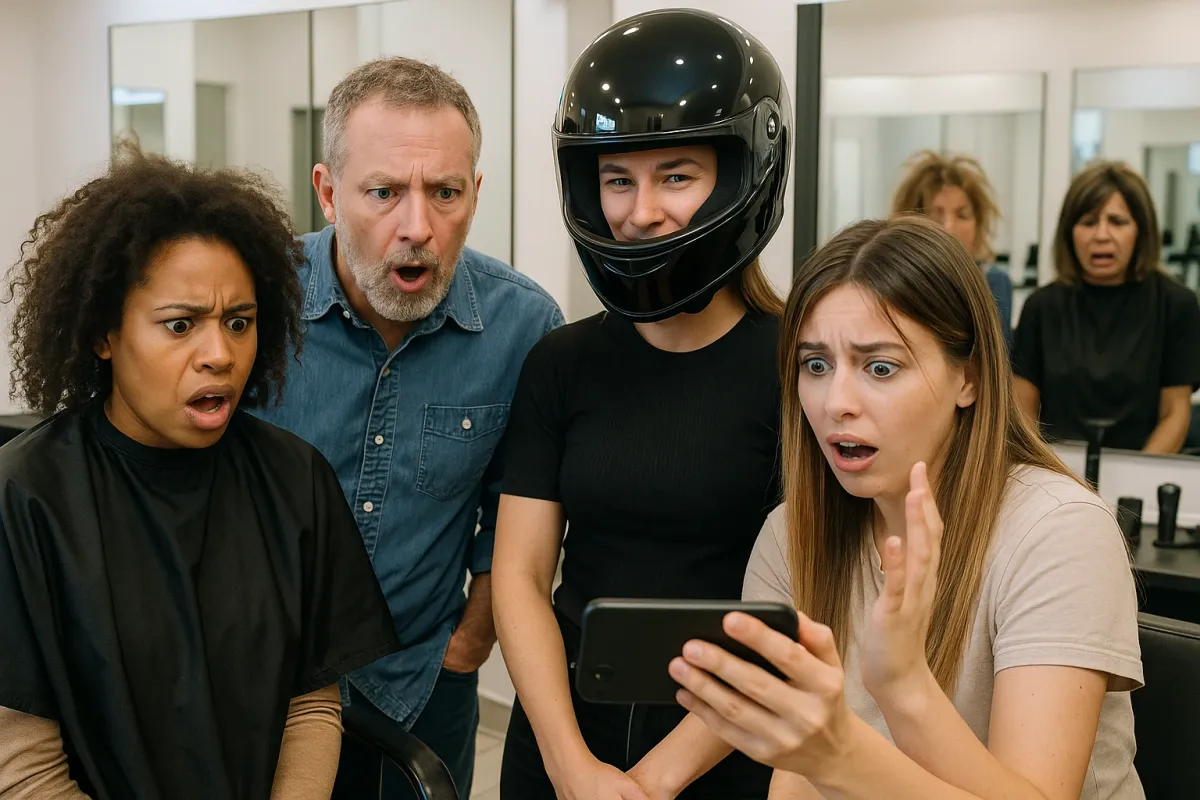
Everyone’s doom‑scrolling those “no words” haircut fails right now—50 brutally bad salon jobs bouncing around social feeds faster than a MotoGP highside. It’s hilarious until you remember: most riders still treat their helmet like a hat, not a precision tool designed to manage hair, sweat, impact energy, and high‑speed airflow all at once.
While the internet laughs at fringe catastrophes and botched dye jobs, there’s a very real, very current conversation happening in parallel: how much tech is actually sitting between your scalp and the asphalt? If you’ll obsess over a bad fade, you should absolutely obsess over what your lid is made of and how it interfaces with your head, hair, and heat.
Let’s use the viral hair‑nightmare trend as a wake‑up call: your helmet isn’t just hiding your bad hair day—it’s a piece of gear whose details matter at a microscopic, biomechanical level.
Below are five deeply technical points serious riders should understand about modern helmets and head‑related gear, right now.
1. Shell Materials: Why “Fiberglass” Isn’t Just Fiberglass Anymore
On social, everyone can spot a bad haircut from 10 pixels away. But most riders still can’t tell what their helmet shell is actually doing when it hits the ground.
Modern shells fall into a few main families:
- Polycarbonate / ABS
- Typically used on mid‑price lids from brands like HJC and some Scorpion models.
- Advantages: cheaper, impact‑tough, can handle multi‑point hits decently.
- Trade‑off: requires more material for the same protection → heavier. Over a 2‑hour ride, that extra 150–250 g translates to real neck fatigue.
- Fiberglass composites
- Found in helmets from Shoei, Arai, and higher‑end AGV models.
- Usually a lay‑up of glass fiber, sometimes with organic fibers or basalt.
- Designed to flex and fracture in a controlled way, spreading energy over a wider area of the EPS liner.
- Lighter than polycarbonate at equivalent strength.
- Carbon fiber / hybrid carbon‑aramid shells
- Used in race‑oriented lids like AGV Pista GP RR, Shoei X‑Fifteen, and high‑end Shark and LS2 race models.
- Unidirectional or woven carbon layers tuned for stiffness in specific directions.
- Critical detail: Too stiff is bad. If the shell barely deforms, it can transmit more peak energy into your head. Good designs combine carbon with aramid or fiberglass to tune flex and fracture patterns.
- Pay attention to certifications and weight—a “carbon” helmet at 1600 g is usually more fashion than engineering.
What to do right now:
Next time you see a “carbon” helmet trending on Instagram, dig into the data:
- Weight in size M (aim for ~1300–1450 g for a sport or street lid).
- Certification (more on ECE 22.06 vs 22.05 vs DOT vs Snell below).
- Shell construction details: how many shells, which fibers, and what lay‑up strategy the brand actually discloses.
If your current lid is a heavy polycarbonate unit and you’re riding 3+ times a week, upgrading to a composite shell is one of the most noticeable comfort and safety improvements you can buy.
2. EPS and Multi‑Density Liners: The “Invisible” Tech That Actually Saves Your Brain
Everyone can see a haircut. Almost nobody sees the EPS liner, even though it’s doing the real work when things go sideways.
EPS = Expanded Polystyrene, a foam specifically engineered to crush under impact, converting kinetic energy into deformation and heat.
Modern helmets increasingly use multi‑density EPS:
- Soft EPS layers manage low‑speed impacts and smaller knocks.
- Medium and hard layers deal with high‑energy crashes.
- Many helmets use zoned densities: softer around the frontal and temporal regions, denser at the crown and occipital zones, where impacts tend to be harder and more direct.
This is evolving right now because of new testing standards:
- ECE 22.06 (replacing 22.05) has pushed manufacturers to:
- Test at more impact points.
- Include oblique/angled impacts.
- Cover broader speed ranges.
Brands like Shoei and Arai have quietly updated or replaced models to meet 22.06, and that’s driven more complex EPS designs—exactly the thing that never shows up in a glossy product photo.
What to do right now:
- Check if your current or next helmet is ECE 22.06 rated (in Europe and many global markets) or Snell M2020 where applicable. DOT alone is a minimum, not a benchmark.
- When shopping, look specifically for “multi‑density EPS” or “zoned EPS liner” in the spec sheet. If a manufacturer says nothing about the EPS, assume it’s a generic single‑density block.
If you’ll complain that your barber didn’t blend your fade, you should definitely care whether your EPS is blended for low, mid, and high‑speed impacts.
3. Rotational Impact Systems: MIPS, Slip Liners, and Why Your Scalp Matters
Those viral “helmet hair” memes miss the serious point: the interface between shell, liner, skin, and hair is now a frontline for rotational impact management.
Brain injuries are often about rotation, not just straight‑line impact. When your head hits the tarmac at an angle, it creates rotational acceleration that can shear delicate brain structures.
That’s where systems like MIPS (Multi‑directional Impact Protection System) and similar slip‑plane technologies come in:
- How it works:
- A low‑friction layer between the comfort liner and EPS allows a few millimeters of relative movement.
- In an angled impact, your helmet shell can rotate slightly while your head rotates less inside, reducing rotational acceleration.
- Who’s doing it right now:
- Scorpion, Bell, and some LS2 models are offering dedicated rotational systems.
- Others (Shoei, Arai, AGV) often use shell + EPS shape and interior contouring to manage rotation without licensed systems, though they don’t always label it clearly.
- Why hair matters:
- A very slick surface (short hair, shaved head, or slick balaclava) can change how your scalp moves relative to the liner.
- Conversely, thick, textured, or bundled hair (braids, big buns) can create pressure points and irregular contact, potentially compromising how the EPS compresses and how a slip liner behaves.
What to do right now:
- If you have long hair, avoid big knots or high buns under the lid. Keep hair low and flat—braids or low ponytails routed below the occipital pad help maintain even contact.
- Consider a thin, non‑slip, moisture‑wicking balaclava. Besides hair control and hygiene, it creates a more predictable friction layer for any rotational system to work with.
- When choosing a helmet, look beyond the marketing: Is there a rotational impact solution, either branded (MIPS, etc.) or explicitly mentioned in the design?
Your vanity might hate “helmet hair,” but your neurons will appreciate a slip‑plane more than the perfect blowout.
4. Ventilation and Microclimate: Real Airflow vs. Noisy Marketing
Those 50 catastrophic haircuts blowing up your feed have one common thread: someone overheated, rushed, or skipped the details. Helmets aren’t any different—ventilation is a system, not just a couple of holes for style.
Serious lids treat airflow as an engineered circuit:
- Inlets at the chin, brow, and crown feed air in.
- Internal channels in the EPS guide it across the scalp.
- Exhausts at the rear create a pressure differential that actively pulls warm, moist air out.
Key technical factors you should be looking for:
- Channel depth and continuity
- Remove the comfort liner if you can and look for deep, continuous grooves in the EPS.
- Shallow or broken channels = marketing vent, not functional vent.
- CFD‑driven design
- Brands like Shoei (X‑Fifteen), AGV (Pista GP RR), and HJC (RPHA series) use Computational Fluid Dynamics to tune vent shape and placement.
- The result: more actual airflow at speed with less noise and less buffeting.
- Microclimate control
- Anti‑bacterial, moisture‑wicking interior fabrics reduce sweat build‑up.
- Removable, washable liners are non‑negotiable for year‑round riders.
- A proper chin curtain and breath deflector can manage fogging without choking off all airflow.
What to do right now:
- If you fog easily or ride in humid climates, prioritize real vent architecture over graphics or “race replica” paint.
- In the shop, close all vents, then open each one while wearing the lid—feel for actual internal flow, especially across the forehead and crown.
- Pair your helmet with a Pinlock or similar anti‑fog insert; it’s a bigger real‑world upgrade than most riders realize.
Your hair might look like a crime scene when you pull the helmet off, but the right microclimate setup will keep your scalp cooler, your visor clearer, and your focus sharper.
5. Fit, Pressure Mapping, and Why “One Size Fits Most” Is a Red Flag
Bad haircuts often start with a bad consultation: wrong head shape, wrong assumptions. Helmets are no different—fit is your primary safety system.
Key technical aspects of fit that serious riders should understand:
- Internal head shape
- Most brands build around one of three main shapes:
- Long oval (front‑to‑back longer, narrower sides)
- Intermediate oval (most common)
- Round oval (short front‑to‑back, wider sides)
- A long‑oval rider in a round‑oval helmet (or vice‑versa) will either develop hot spots or over‑size to feel “comfortable,” destroying safety.
- Multi‑shell sizing
- Good helmets use 2–4 different shell sizes across the S–XXL range.
- Cheaper lids often use one shell and just swap EPS thicknesses. That can mean a small rider wearing a shell that’s physically too big, which compromises both aerodynamics and energy management.
- Pressure distribution
- Correct fit means even, firm contact around most of the head, with no single area screaming for mercy after 20–30 minutes.
- You should feel light pressure at the cheeks (they will break in), stable contact at the crown, and no hard points at the temples or forehead.
- Modern fit tools
- Some premium shops and brands are beginning to use 3D head scanning and pressure mapping to match lids to riders. This is still emerging but growing fast in 2025, especially in Europe and Japan.
- Until that’s common everywhere, you are your own pressure sensor—take the time.
What to do right now:
- Put on the helmet, fasten the strap, and wear it for at least 10–15 minutes before judging fit. Subtle pressure hot spots need time to show up.
- Perform this check:
- Shake your head side to side and up/down. The helmet should move with your skin, not slide over it.
- Try to roll it off forward and backward with the strap fastened—it should stay locked on.
- If you ride often and aggressively, don’t be afraid to swap cheek pads or interior pieces to tune fit. Many mid‑ and high‑end brands offer multiple pad thicknesses.
You’d never accept a barber saying “one cut fits all.” Don’t accept “one shell fits all” from a helmet, especially when you’re trusting it with everything from your skull to that questionable dye job.
Conclusion
While the internet roasts tragic haircuts and color catastrophes, riders have a sharper question to answer: if you care that much about what’s on your head, why aren’t you obsessing over what’s around it?
Right now, helmet tech is evolving fast—driven by stricter standards like ECE 22.06, smarter shell composites, multi‑density EPS, rotational impact systems, and CFD‑tuned aerodynamics. At the same time, social feeds are full of people worrying about bangs and balayage.
Let them.
You’ve got more serious work to do: audit your current lid, understand its shell, EPS, rotational management, ventilation, and fit. If any of those are a mystery, that’s your cue. Upgrade with intent, not just for graphics—and treat your helmet like the precision safety instrument it is.
Bad hair grows out. Bad head protection doesn’t get a second chance.
Key Takeaway
The most important thing to remember from this article is that this information can change how you think about Gear & Equipment.