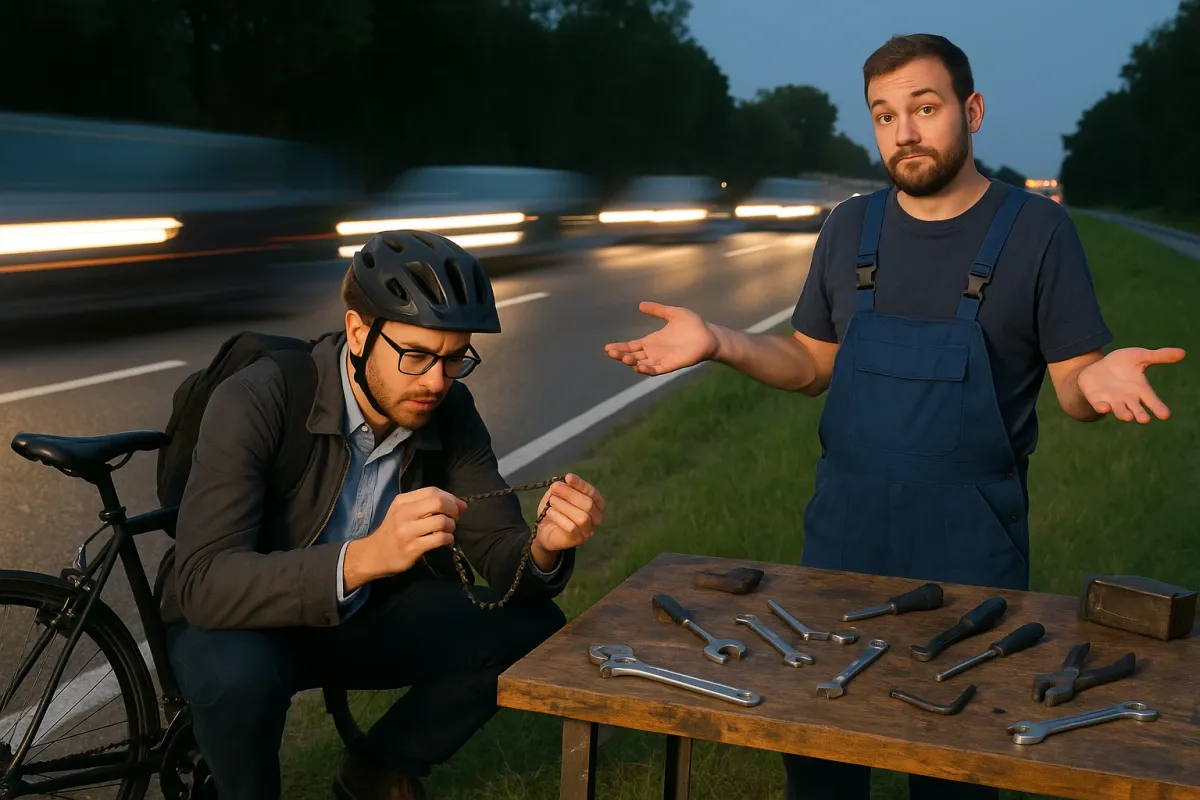
There’s a viral Bored Panda piece making the rounds right now: people sharing “Not My Job” moments—photos of hilariously lazy work where someone technically did the task, but absolutely didn’t care how. A crosswalk painted over a manhole cover. A “wet paint” sign… on dry concrete. That kind of thing.
Funny on the internet. Catastrophic on a motorcycle.
If you ride, you cannot afford “not my job” thinking in your maintenance. Yet it’s everywhere in our world: the shop that air-guns your axle nut without a torque wrench, the tech who stamps your service book but never checks chain slack, the rider who says, “It starts, so it’s fine.” This article takes that trending “lazy job” theme and turns it into a hard look at five critical systems where half‑hearted maintenance can quietly set you up for a high‑speed lesson in physics.
1. Chain & Sprockets: Where “Good Enough” Becomes 80 mph Shrapnel
Most riders know they should lube the chain. Fewer treat it like the load‑bearing, high‑speed, flesh‑eating component it actually is.
Key technical checks (every 500–1,000 km or after wet rides):
- Chain slack, measured precisely
- Typical spec: 25–35 mm vertical movement (check your manual).
- Too tight = destroys output shaft bearings and can bind the suspension.
- Too loose = lash, snatchy throttle, risk of chain derailment.
- Alignment, not just “rear wheel straight”
Don’t eyeball it. Measure at the midpoint between sprockets, in the tightest section of the chain.
Those swingarm hash marks? They’re guidelines, not gospel. Use a chain alignment tool or a straightedge along the rear sprocket to the front. Misalignment accelerates wear and can make the bike weave slightly under load.
- Hooked teeth and “shark fins”
- Normal: symmetrical profile, slight wear on drive side.
- Replace: visibly hooked teeth, thinning at the tip, or “leaning” in one direction.
Inspect the rear sprocket teeth:
If sprocket teeth are visibly deformed, your chain is already past its best.
- Stretch vs. binding
Measure chain length over a set number of links (often 20 pins) and compare to the spec. Also spin the wheel and check for tight spots. A chain with uneven tension is done, even if it still “looks okay.”
- *Replace as a set
Chain, front sprocket, rear sprocket—together. Mixing new with worn is textbook “not my job” corner‑cutting and will nuke the fresh parts fast.
On social media, people laugh at photos of a stair painted around a leaf. On your bike, the same mindset produces a chain that looks shiny but is one hard acceleration away from snapping.
2. Braking Systems: When Pad Changes Become Russian Roulette
If there’s one place lazy work has zero tolerance, it’s your brakes. Yet “pad slap” jobs—where old fluid, dirty calipers, and uninspected discs are ignored—are unbelievably common.
What a proper brake service really looks like:
- Pad thickness and evenness
- Measure inner vs. outer pad thickness. Uneven wear can mean seized caliper pins or stuck pistons.
- Glazed pads (shiny, glassy surface) often come from overheated or cheap compound pads—replace, don’t just scuff.
- Rotor (disc) inspection with numbers, not vibes
- Use a micrometer to measure rotor thickness in multiple spots. Compare to the minimum thickness stamped on the disc (e.g., 4.0 mm).
- Use a dial indicator to check runout if you’re chasing pulsing or vibration. Typical max: 0.1–0.2 mm (varies by manufacturer).
Don’t just check “is there material left?”
Half‑assing this results in mystery “ABS faults,” judder, and cracks.
- Fluid as a performance part
- Street riding: flush every 1–2 years max.
- Aggressive or track use: annually or more.
Brake fluid is hygroscopic—it absorbs water and lowers boiling point.
Lazy shops will just top off dark, cooked DOT 4. A proper flush pushes clear fluid through each caliper, bleeding in the manufacturer’s sequence.
- Caliper pins and piston health
Remove, clean, and lightly grease sliding pins with high-temp brake grease.
Carefully scrub piston faces with a dedicated cleaner and soft brush before pushing them back in. Shoving dirty pistons into their seals is the brake equivalent of painting right over mold.
- Torque, not “feels tight”
Caliper bolts, banjo bolts, and disc bolts get torqued to spec with a calibrated wrench. Over-tightening can distort rotors or crush washers; under-tightening can be catastrophic.
Those “Not My Job” photos of stop lines painted over potholes are funny because someone will eventually fix the road. Nobody is coming to fix your braking distances for you.
3. Tires & Pressures: The Subtle Sabotage of “Close Enough”
Tires are where lazy maintenance hides in plain sight. They’re round. They’re black. They hold air. End of story—right up until a panic stop in the rain.
Dial in your tire game with precision:
- Pressures checked cold, with a known‑accurate gauge
- Check before the ride, not after a 20‑minute highway run.
- Follow the bike’s recommendations first (swingarm sticker), then adjust for load/pace if you know what you’re doing.
- Front vs. rear wear patterns tell stories
- Squared-off rear: lots of highway, too little pressure, or both.
- Cupped front: underinflation, worn suspension, or cheap/old tire.
- “Blueing” or small surface tears: overheating, too low pressure, or aggressive riding on a tire not designed for it.
- Date codes matter
Don’t trust random gas station compressors. Get a quality digital or analog gauge.
Every tire has a DOT code: last four digits = week and year (e.g., 1823 = week 18 of 2023). Over 5–6 years old, even a tire with plenty of tread can harden and lose grip. It’s the tire equivalent of using 10‑year-old “still sealed” brake fluid.
- Match tires for intent, not just brand
Mixing a hypersport front with a budget touring rear because “that’s what was on sale” is how you end up on r/ridingfail videos. The interaction between front and rear carcass stiffness and compound is designed as a pair.
- Valve stems & caps are not decoration
Rubber stems crack with age and heat; metal, angled stems on many modern bikes are a functional upgrade. Valve caps with seals prevent slow leaks and contamination. Running without caps is the tire-world equivalent of those viral photos of outlets half‑covered by fresh paint.
A few PSI off might not crash you today. But stretched over months, that’s lazy, invisible sabotage of grip, handling, and braking.
4. Electrical & Charging: The Silent Victim of “As Long As It Starts”
Most riders ignore their bike’s electrical system until it fails. Modern bikes, packed with rider aids and electronics, are less tolerant of half‑baked wiring work than ever.
Core checks that separate pros from “just works”:
- Battery health, not just voltage
- Perform a load test or watch voltage while cranking: if it nose‑dives below ~10V regularly, replacement time is near.
- Lithium batteries need compatible chargers; hitting them with an old-school automotive charger is modern-day “not my job” vandalism.
- Charging system verification
- Idle: typically 13.0–13.5V
- 3–5k rpm: usually 13.5–14.5V
A resting 12.7V battery can still be weak.
With the bike running, measure voltage at the battery:
Much lower = stator/regulator issues; much higher = overcharging regulator, which can cook batteries and ECUs.
- Connectors: clean, tight, unmolested
Corroded or heat‑browned connectors (especially stator–regulator and main grounds) are early warning signs.
Use proper contact cleaner and dielectric grease on appropriate plugs. Don’t twist, bend, or “improvise” with pliers.
- No vampire taps, no hardware‑store wire
- Use marine‑grade, tinned copper wire.
- Solder + heat‑shrink or high‑quality, weather‑sealed crimp terminals.
- Route along factory harnesses, away from heat and pinch points.
- Ground paths checked like they matter (because they do)
Crimp connectors, Scotch‑locks, and speaker wire on a motorcycle harness are exactly the “painted around the problem” energy from that viral article.
Remove main grounds, clean to bright metal, and reassemble with proper torque. Many head‑scratching intermittent electronic glitches are nothing more than lazy ground maintenance.
On social feeds, everyone’s entertained by photos of “EXIT” signs installed pointing at a wall. On a bike, the equivalent is random, un‑fused accessory wiring cable‑tied to your steering head—and the punchline is a small fire.
5. Fluids & Torque: The Invisible Art of Doing It Right or Not At All
Oil changes and bolt tightening are where “not my job” thinking thrives. It’s easy to look like you did the work: new filter, fresh oil, drain plug in place. But the details are where engines live or die.
Elevate your fluid and fastener game:
- Oil: spec first, brand second
- Cold climates: your 10W‑40 might be a mistake where 5W‑40 is spec’d.
- High‑revving engines: shearing can destroy generic automotive oils faster than you think.
- Drain plugs and crush washers: a system, not a bolt
- Always inspect threads in the pan and on the plug. Any gritty feel or visible tearing deserves a closer look.
- Use a new* crush washer unless the design explicitly reuses it.
- Torque to spec, then verify no weeping after a heat cycle. Over‑tightening is what leads to those viral horror pics of helicoil repairs and JB‑Welded sumps.
- Coolant: chemistry matters
- Use manufacturer‑approved, silicate‑free, motorcycle‑compatible coolant.
- Flush intervals: typically every 2–3 years.
- Inspect radiator fins, hoses, and clamps during every major service.
- Torque wrenches, calibrated and used correctly
- Store at its lowest setting.
- Recalibrate periodically if you use it often.
- Learn the correct torque sequence for multi‑fastener assemblies (e.g., axle pinch bolts, triple clamps).
- Service logs as engineering data, not paperwork
Viscosity and certification (JASO MA/MA2 for wet clutches) matter more than logo preference.
Mix wrong coolants or tap water into your system and you invite galvanic corrosion.
A torque wrench that’s been dropped, never recalibrated, and always stored at max setting is an instrument of chaos.
Keep a precise record of fluids used, torque values for critical fasteners, and date/mileage. Over time this becomes a diagnostic tool: you’ll see patterns in consumption, wear, and component life.
Those “Not My Job” photos go viral because they show obvious, visible laziness. Proper fluid and torque management is the opposite: you never see the disaster, because it never happens.
Conclusion
The internet is laughing right now at some poor traffic worker who painted a double yellow line over a crushed soda can. It’s funny because it’s harmless and obvious.
On a motorcycle, lazy maintenance is neither.
Your chain tension, caliper health, tire pressures, charging system, and fluid/torque discipline are the difference between a bike that feels dialed and one that’s quietly trying to kill you. The world is full of “not my job” moments—but your bike isn’t the place for them.
Treat every maintenance task as if someone who truly understands motorcycles is going to inspect your work. Because ultimately, they will.
That someone is the road.
Key Takeaway
The most important thing to remember from this article is that this information can change how you think about Maintenance.