Most riders don’t crash because of one dramatic mistake. They crash because of small, repeated bad habits that feel “normal” right up until the moment everything goes sideways. That’s why that viral BoredPanda piece, “People Share ‘Red Flags’ They Ignored In Their Relationships That Turned Out To Be Very Toxic,” hits so hard—even for riders. On the road, those same ignored red flags show up in our throttle hand, our lane position, and our ego.
Right now social media is full of people dissecting emotional red flags in relationships. Riders should be doing the exact same thing with their riding. The uncomfortable truth: your “toxic” habits on two wheels will not just break your heart. They can break your body. So let’s drag them into the light.
Below are five brutally honest, technical riding “red flags” that signal real risk—plus how to fix them before they turn into an incident report.
1. You Ride “On Feel” But Can’t Describe Your Braking Distances
If I ask you, “From 60 mph, roughly how many meters do you need to stop on dry tarmac with good grip?” and your answer is “uh… depends,” that’s a red flag.
Modern ABS-equipped bikes can stop from 60 mph (≈100 km/h) in the 30–40 m range under test conditions. You, on a public road, will rarely match that—reaction time alone usually adds 10–20 m before you even touch the lever. At 60 mph you’re covering about 27 m per second. A 0.7 s reaction time (pretty average) is ≈19 m of “thinking distance” before your actual braking distance even starts.
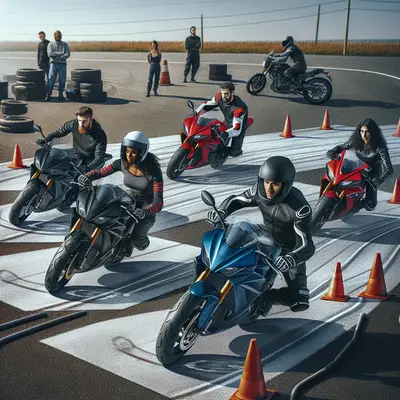
If you never think in these terms, you’ll naturally tailgate, overestimate your grip, and underestimate how badly a distraction or sudden hazard (car door, pedestrian, oil patch) will punish you. The fix is low-drama but very technical: go to an empty lot or training facility and practice progressive emergency braking from 20, 30, 40 mph, measuring rough stopping distance with cones or landmarks. Feel the front tire approach the point of ABS activation or light chirp (on non-ABS bikes, you stop just before lockup). Log the distance in a notebook or notes app. This rewires your brain from “I think I’ll stop in time” to “I know I cannot stop from here if that car brakes hard.”
If your following distances, corner entry speeds, and gap choices don’t change after doing this, you’re ignoring a major red flag.
2. Your Vision Is Locked On “What’s Next” Instead Of “What’s Coming”
In that BoredPanda article on relationship red flags, people kept saying, “I saw the signs, I just didn’t want to look at them.” On a bike, target fixation is the literal version of that. You ride exactly where your eyes decide to live.
A technical sanity check: on a 50 mph back road, you should be scanning at least 8–12 seconds ahead. That’s roughly 180–300 m of road. Yet most riders fixate 2–4 seconds ahead (30–60 m), especially mid-corner. That brutally shortens your reaction window and forces panic inputs—mid-corner braking, abrupt steering, or rolling off abruptly and upsetting chassis balance.
Red flags in your vision habits:
- You can’t describe road features 5–10 seconds ahead while riding (driveways, side streets, surface changes).
- You feel “surprised” by every tightening radius corner.
- You often find yourself mid-corner needing the brakes.
- Far field (8–12s): primary, always scanning the vanishing point, horizon, and upcoming changes in line or camber.
- Mid field (3–5s): where your path is being refined—entry, apex, exit, escape routes.
- Near field (0–2s): checked only briefly for surface detail—gravel, tar snakes, manhole covers.
The technical fix is what advanced instructors call the “visual funnel.” You maintain three layers of vision:
Practice on a known stretch of road at moderate speed. Force yourself to verbally label what’s 8–10 seconds ahead (“tight right, crest, then junction on left”), even if only in your helmet. If you can’t narrate ahead, your eyes are too close to the front wheel—a flashing red flag that will eventually show up as panic.
3. You “Lean The Bike” But Don’t Understand Load Transfer
Most riders talk about lean angle but ignore the underlying physics: load transfer—how much weight each tire is carrying as you brake, accelerate, or turn. Relationship red flags often come down to unequal emotional load; riding red flags come from unequal physical load you don’t account for.
Under braking, weight shifts forward. A moderate 0.5 g decel on typical road rubber can easily move 70–80% of the total load to the front tire. That massively increases available front grip, while rear grip drops. If you’re still using “50/50” braking in a real emergency, that’s a red flag—you’re asking the unloaded rear to do work it simply can’t.
In a corner, the combined vector of lateral and longitudinal forces must stay inside the tire’s traction circle. If you’re chopping throttle mid-corner, jabbing the rear brake, or standing the bike up every time you’re startled, you’re drawing wild zigzags across that traction circle instead of precise arcs.
Actionable fix:
- Braking drills: In a safe area, work on front-biased braking—start 60% front / 40% rear and progress toward 80/20 as your feel improves. Focus on smooth initial squeeze, then firm build, then gentle release as the bike slows and weight shifts back.
- Corner exits: Practice maintenance throttle—a slight positive throttle to keep the suspension settled from apex to exit. This keeps load relatively stable and prevents abrupt geometry changes.
- Single-input discipline: One significant control change at a time—either brake, steer, or throttle. Combining large inputs (e.g., heavy braking while turning in) without precise technique is a red flag for traction overload.
If you can’t explain what your tires are “feeling” under you in each phase—entry, mid, exit—you’re riding on faith, not physics.
4. Your Lane Position Is About Habit, Not Information
That BoredPanda workplace toxicity article talks about people realizing “the whole environment was wrong, not just one argument.” Road environments are similar: if you always sit in the same part of the lane, regardless of traffic, curvature, or surface, your whole environment is working against you.
Technical riding is about information dominance—seeing and being seen early. Lane position is your primary tool for that.
Red-flag habits:
- Always riding center-lane, even on curves or behind traffic.
- Hugging the inside of a curve because it “feels safer” (it isn’t—you sacrifice sight distance).
- Sitting in blind spots next to B-pillars or SUVs because you like the “open space.”
- Outside–Inside–Outside for vision, not speed: Approach a right-hander from the left track (outside), hold a late apex that maximizes view through the corner, then drift out if needed. Mirror for left-handers. Your priority is sight line, not Rossi cosplay.
- Staggered positioning in traffic: Behind a car, choose the wheel track that gives maximum view past it—usually left track behind the left rear wheel in right-hand traffic. This also makes you more visible to oncoming traffic.
- Dynamic lane: surface + threats: Constantly factor in manhole covers, diesel spills, crown of the road, and crosswind direction. Your lane placement should change dozens of times in a short ride; if it doesn’t, that’s a red flag you’re riding on autopilot.
Key technical adjustments:
Record a ride (chest or helmet cam) and later mute the audio and just watch your lane position choices. If you can’t justify most of them in terms of vision, space, and escape routes, you’ve got habits to rewrite.
5. You Treat Fatigue And Emotion As “Excuses,” Not Risk Multipliers
Those viral “toxic workplace” and “calling in sick for weird reasons” posts are funny because people push through days when they absolutely shouldn’t. Riders do the same—but the cost of “I’ll just push through” on two wheels is much higher.
Cognitive performance drops sharply with fatigue, stress, and distraction. Multiple studies equate 17 hours awake to a blood alcohol level of ~0.05%; 24 hours awake is closer to 0.1%—legally drunk in most jurisdictions. You would never brag about riding drunk, but many riders brag about “smashing 800 miles on 4 hours of sleep.”
Red-flag indicators:
- You regularly ride after emotionally draining arguments, night shifts, or long-haul flights.
- Your reaction to a near-miss is anger at the other driver, not an audit of your own condition.
- You notice more gear “forgotten” (earplugs, back protector, checking tire pressures) on days you’re tired or stressed.
- Pre-ride checklist with a “GO/NO-GO” line: Sleep last 24h, caffeine intake, hydration, food, emotional state. Set a hard threshold: e.g., if you’ve slept <5 hours and are starting a ride over 2 hours long, it’s an automatic NO-GO or reduced route.
- Session caps: On spirited rides, limit continuous “attack mode” to 20–30 minutes, then a legit 5–10 minute decompression: visor up, gloves off, a few breaths, quick bike walk-around.
- Objective metrics: Use a smartwatch or app to track HRV, resting heart rate, and sleep. If your biology is screaming “you’re cooked,” treat that as seriously as low oil pressure.
Technical countermeasures:
If your pride talks you onto the bike when your brain clearly shouldn’t be there, that’s the loudest red flag of them all.
Conclusion
Those BoredPanda stories about ignored relationship and workplace red flags are going viral because people recognize themselves in them. Riders need that same uncomfortable mirror. The “toxic” patterns that ruin relationships have direct analogs in our riding: ignoring data, normalizing bad behavior, and hoping consequences never arrive.
Motorcycling doesn’t usually punish you instantly. It lets you get away with sloppy vision, lazy lane position, vague braking, and ego-driven fatigue—right up to the moment it doesn’t. The riders who stay in the game for decades are brutally honest with themselves long before the crash report gets written.
Audit your own red flags: how you brake, where you look, where you sit in the lane, how you manage your energy. Fixing them isn’t Instagram-glamorous. It’s quietly technical, humbling work. But that’s exactly the work that keeps you riding hard, riding long, and riding home.
Key Takeaway
The most important thing to remember from this article is that this information can change how you think about Riding Tips.