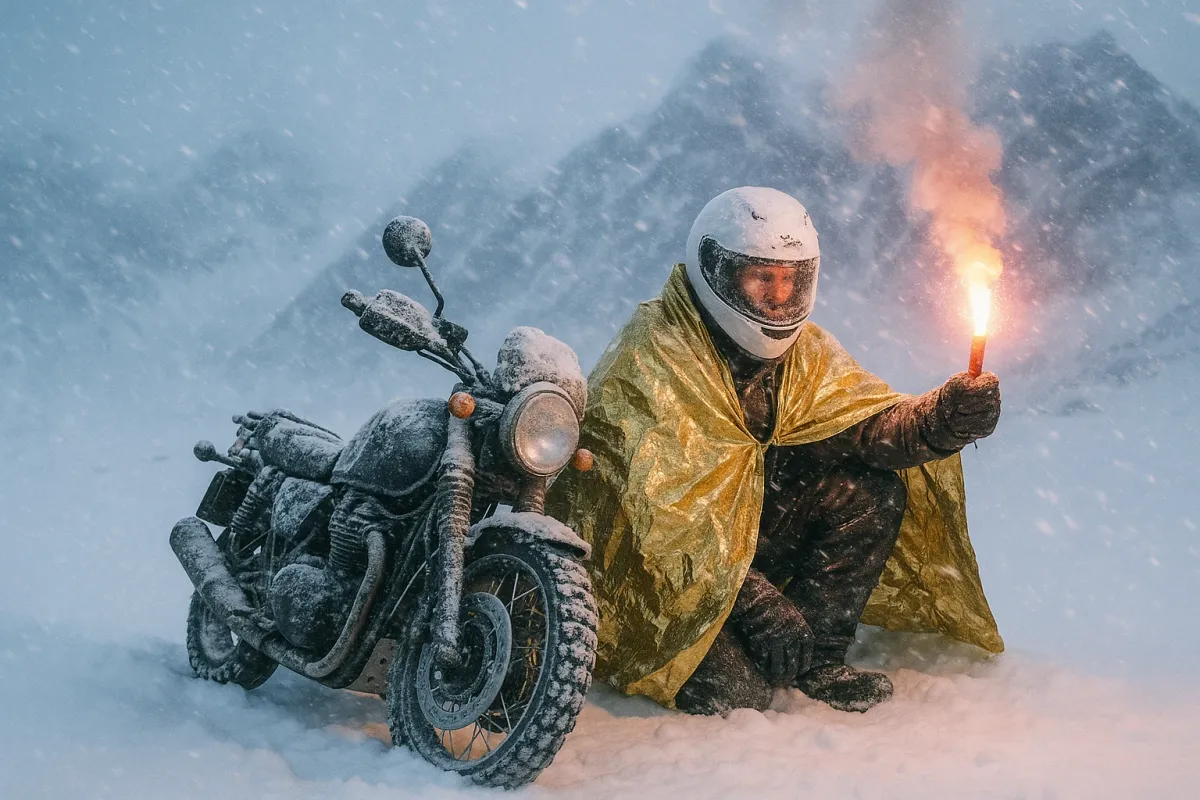
A real story just shook Europe’s mountaineering community: 33‑year‑old Kerstin Gurtner, abandoned by her boyfriend on Austria’s highest peak, froze to death on the Großglockner. He’s now facing negligent homicide charges. It’s a brutal reminder that in the mountains, the environment is unforgiving, and bad decisions don’t get second chances.
If you ride a motorcycle into real winter—alpine passes, frosty rural backroads, or even cold, dark commutes—you’re playing in the same arena. Hypothermia, poor judgment, and “I’ll just push through” bravado kill riders every year. This isn’t about fear; it’s about respecting physics, temperature, and your own limits as ruthlessly as the mountains do.
Below are five technical, no‑nonsense cold‑weather riding principles built around one idea: don’t let the environment slowly beat you into bad decisions.
Build A Thermal System, Not Just A “Warm Jacket”
Most riders treat winter gear like fashion layers. In alpine conditions, you need a thermal system engineered like mountaineering kit:
- Base layer (skin management): Go synthetic or merino, snug but not constricting. You want fabric that moves sweat away from skin (wicking), not cotton that holds moisture and accelerates heat loss. In real numbers: a soaked cotton layer can increase conductive heat loss by 30–40% versus a high‑performance synthetic.
- Mid layer (insulation): Fleece or light puffy. The job here is to trap air. Air is the insulator; the fabric is just the scaffolding. Focus on chest, back, and upper arms—these zones drive perceived core warmth and slow the onset of shivers, an early hypothermia flag.
- Outer shell (weather barrier): A laminated waterproof/breathable shell (Gore‑Tex, D‑Dry, Hydratex, etc.) with minimal vents and good collar and cuff seals. At 60 mph, a 5°C ambient temperature with windchill effectively feels like ‑2°C on exposed skin. Your shell’s job is to make that number irrelevant.
- Hands and feet: A technical weak link. Use long‑gauntlet, insulated, waterproof gloves that overlap your jacket. For boots, think insulation plus volume: a thin thermal sock inside a roomy boot is warmer than a thick sock crammed into a tight one (compressed insulation = lost trapped air).
- Fit and compression: If your layers are tight, you’re losing the air gap that actually insulates. You should be able to take a full breath, cross your arms, and reach the bars without anything pulling.
Translate mountaineering thinking to the bike: dress for immobility. If you had to stand next to your broken bike for two hours at that temperature, would your system keep you functional?
Learn The Numbers: Cold, Fatigue, And Riding Errors
Kerstin Gurtner wasn’t killed just by low temperature; she was killed by a cascade of poor decisions under physiological stress. Cold does the same thing to riders—silently.
Understand how hard numbers translate to risk:
- Core temperature drop from 37°C to 35°C (mild hypothermia):
- Reaction times slow measurably.
- Fine motor control degrades—finger precision on levers disappears.
- You start making “shortcut” decisions: late braking, skipping checks, over‑riding visibility.
- Hand temperature and braking force:
- Below about 10°C skin temperature, grip strength can drop 20–25%.
- That’s the difference between a firm two‑finger stop and a mushy lever pull that adds 2–3 meters to your stopping distance at 60 km/h.
- Mental fatigue curve: In cold, cognitive fatigue ramps faster. After 60–90 minutes of sustained exposure, your mental “buffer” for surprises—deer, ice patches, incoming corners—shrinks. You feel okay, but your decision tree gets lazier.
- Stop every 60–75 minutes in low single‑digit °C temps.
- Do a 30‑second self‑check: are you shivering, fumbling zips, missing details around you, or making small “whatever, it’ll be fine” calls? Those are your early‑warning lights, not hero badges.
Practical rule for winter rides:
If your body is fighting the cold, it’s not fully riding the bike. Treat temperature like you treat tire wear or fuel range: a hard performance limit, not a vague discomfort.
Engineer Your Controls For Gloves And Numb Hands
Kerstin’s story is about betrayal, but the mechanical version of betrayal in winter riding is your own cockpit: controls that worked great in July suddenly become unsafe in January.
Set the bike up specifically for gloved, partially numb hands:
- Levers:
- Adjust both front brake and clutch so engagement is closer to the bar. Thick winter gloves + long lever travel = late braking events.
- Slightly increase lever free play within spec to avoid dragging, but ensure the bite point is predictable and repeatable with bulky gloves.
- Heated grips and guards:
- Heated grips are non‑negotiable in real winter. Use them intelligently: medium setting early in the ride is better than “max” after your hands are already numb.
- Handguards don’t just block wind; they reduce convective heat loss. Even cheap ADV‑style plastics dramatically improve glove performance.
- Throttle finesse:
- Cold rubber is stiffer. Test your return spring and throttle tube in low temps; a sticky winter throttle is not hypothetical, it’s common.
- If your bike has ride modes, use a softer map in icy conditions to maintain controllability with less precise input.
- Switchgear usability:
- Go sit on your bike in full winter kit. Can you reliably operate indicators, high‑beam flash, horn, and kill switch without looking? If not, reposition controls or add tactile markers (small stick‑on bumps or textured tape). Under stress, you won’t be looking for switches—you’ll be guessing.
In mountaineering, gear is pre‑rigged for use with thick gloves and reduced dexterity. Copy that mindset. If your setup only works when you’re warm and barehanded, it’s not winter‑ready.
Read Winter Surfaces Like A Mountaineer Reads Snow
The Austrian tragedy centered on ice, snow, and exposure. Riders face a similar enemy: surfaces that visually lie to you. Winter roads can appear uniform but vary wildly in grip within a single lane.
Refine your surface reading like a professional:
- Radiation vs. ambient temperature:
- A road can be above freezing while shaded sections—bridges, tree‑covered bends, north‑facing cuttings—sit at or below 0°C. That’s where “black ice” and refrozen melt hide.
- Any spot where the sun hasn’t touched pavement all day is automatically a reduced‑traction zone, regardless of the dashboard temp.
- Micro‑texture cues:
- True black ice = glassy, mirror‑like, sometimes with a faint brown or blue cast.
- “Wet but grippy” asphalt still shows coarse aggregate texture. If the surface looks smooth and unevenly glossy, treat it like spilled diesel or polished marble.
- Line selection in winter:
- Avoid the shiny car‑polished center of the lane when temperatures hover near freezing. Run slightly off‑center where the asphalt has more macro‑texture and often better drainage.
- In roundabouts and tight turns, massively reduce lean angle and rely more on body position than throttle aggression. Aim for “minimum necessary lean, maximum smoothness.”
- Input discipline:
- No sudden anything: no snap‑throttle, no panic downshifts, no abrupt brake grabs.
- Front brake: start with a very light initial squeeze to load the tire, then build pressure. On questionable surfaces, bias slightly more to the rear while standing the bike up as much as possible.
Visualize yourself as a skier reading snowpack: always asking, “What changed in the last 20 meters?” not “Does this generally look okay?”
Plan Like A Mountaineer: Route, Return, And Bail‑Out Logic
One reason prosecutors are going after Kerstin’s boyfriend is decision‑making: route choice, abandonment, and risk acceptance. Winter riders often “abandon” their future selves in the same way—pushing on with no exit plan.
Plan winter rides like an alpine push, not a summer Sunday blast:
- Route design with escape options:
- Favor routes with frequent fuel stops, cafés, or heated buildings over the most scenic desolation. You’re not just planning for riding; you’re planning for stopping safely if conditions tank.
- Identify at least two hard bail‑out points: “If I’m not here by X time or the temp drops to Y, I turn around or divert.”
- Time and light discipline:
- Temperatures can plunge 5–10°C quickly after sunset in valleys and mountains. Design rides so you’re off the bike—or at least off the worst terrain—before dark in mid‑winter.
- If you must ride at night, upgrade your lighting (LED aux lamps, better projector bulbs) and dial your speed back to match your actual stopping distance in that illumination, not your summer memory of the road.
- Communication and tracking:
- Tell someone your route and time window. Basic, old‑school, but still underused.
- If you ride in serious remote conditions, use location‑sharing or a tracker app. Battery hates cold, so keep phones close to your body, not in an unheated top box.
- Psychological bail‑out rule:
- Pre‑commit: “If I even think about whether I should turn around, I turn around.”
- Decision quality plummets in cold. Lock in the rule before you feel pressure to “not be weak.”
The mountains don’t care if you “almost made it.” Neither does a frozen roadside ditch. Plan to succeed, but be ruthlessly willing to abort.
Conclusion
The story of Kerstin Gurtner on Austria’s highest peak is a human tragedy, but it’s also a technical case study: cold, exposure, overconfidence, and catastrophic decision‑making under stress. Riders face a quieter version of that every winter.
Winter isn’t the enemy—but disrespecting it is. Build a real thermal system, understand how cold degrades your control, engineer your cockpit for gloved hands, read winter surfaces like a pro, and plan your route with the same discipline alpinists use on serious climbs.
Ride in winter if you love it. Just don’t gamble that the mountain—or the weather—will cut you a break when you stop taking it seriously.
Key Takeaway
The most important thing to remember from this article is that this information can change how you think about Riding Tips.